Pocket Ants: Colony Simulator
- 4.3
- Rating
- 10.00M
- Installs
- Free
- Price

 Analysis by App-foxy
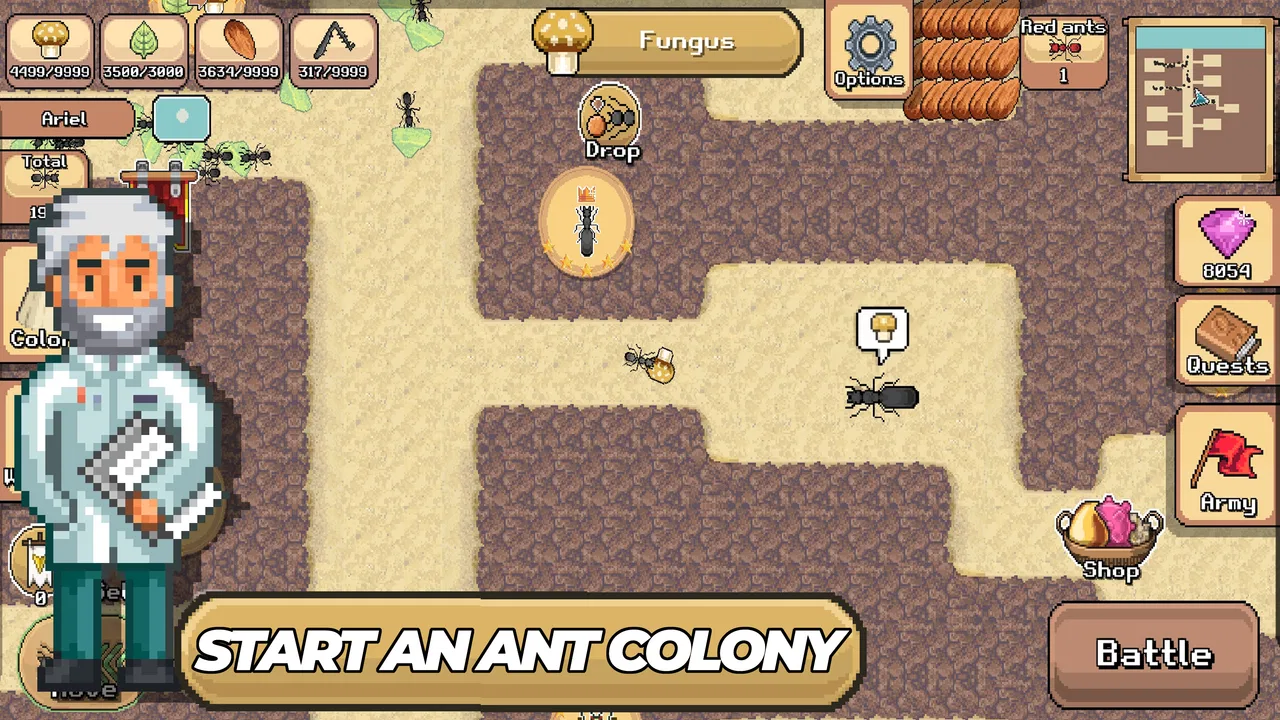
I went into Pocket Ants: Colony Simulator expecting a small strategy game, but its appeal is more hands-on than that label suggests. I am not simply placing buildings and waiting for timers. I spend my time gathering useful materials, improving a nest, growing an army, and deciding when it is worth risking those gains against another colony. That loop gives the game a satisfying sense of purpose, especially during short sessions when I want something active rather than a passive management screen.
It is a free strategy game from Ariel-Games, rated for Everyone, and it has built a large audience with over ten million installs. Its average score sits at 4.3 from roughly 334 thousand ratings, which matches my impression that the basic idea is easy to understand and enjoyable for many players. The important question, though, is not whether the concept sounds appealing. It is whether you enjoy making gradual progress while constantly weighing safety against expansion.
How the colony feels to manage right now
The strongest part of the experience is the connection between small decisions. Resources are not just abstract numbers in a menu; they represent the next improvement, the next group of ants, or the next raid I can realistically attempt. When I focus only on expanding, I can leave the colony poorly prepared. When I spend too cautiously, progress feels slow. The game works best when I treat the nest as an ongoing operation rather than a checklist of upgrades.
You May Also Like

 Blood Strike: 2.5 Anniversary
Blood Strike’s Loadouts Turn Every Drop Into a Tactical Gamble
A close look at Blood Strike’s custom loadouts: how fast access to signature weapons reshapes its battle royale rhythm, rewards preparation, and narrows the gap between fights.

 Pandora - Music & Podcasts
Pandora’s Music Is Easy to Start, but Harder to Recover
Pandora’s strength is its low-effort path from a seed to a station. Its weak spot is how much confidence it asks you to place in connection, setup, and quiet recovery.

 8 Ball Pool
 Is Built on Rivalries, Rematches, and Routine
A close look at the rivalries, rematches, shared routines, and unanswered safety questions that turn a quick pool match into a persistent mobile community.

 Samsung Music
’s Quiet Strength Is Playing What You Already Own
Its reach comes less from spectacle than from dependable access to a personal library. That simplicity is both the app’s strongest retention engine and its ceiling.

 AccuWeather: Weather Radar
AccuWeather Review: A Quick, Clear Forecast for Everyday Decisions
For everyday plans, the best forecast is the one you can understand quickly. AccuWeather makes rain timing, radar, and local conditions easy to act on, with a few trade-offs.

 Hill Climb Racing
Why Hill Climb Racing Still Turns Crashes Into One More Run
A tiny car, a bumpy hill and one more upgrade: Hill Climb Racing keeps resurfacing because its simple chaos makes every near-miss feel personal.
More From Our News Desk



That makes the opening hours approachable. I can understand the main objective without studying a complicated rulebook, and the ant-colony theme gives each action an immediate context. Gathering supports development, development supports the army, and the army creates opportunities to raid. The loop is clear enough for casual players but leaves room for better planning once the first excitement wears off.
I also like that the game encourages me to think in stages. A resource run may look worthwhile until I realize that the colony needs protection first. An attack may promise a useful reward, yet committing too early can leave my own nest vulnerable. This is where the strategy category matters: the game is not only about collecting more, but about choosing the right order for my priorities.
A practical session for a busy day
For me, a realistic session starts during a short break. I check what the nest needs, collect enough material for a specific improvement, and then decide whether I have time to prepare an offensive move. If I only have a few minutes, I can still make one meaningful decision instead of needing a long uninterrupted campaign. On a quieter evening, I can take a more deliberate approach by building up resources, strengthening the colony, and planning a raid around that preparation.
This flexibility is one of its everyday strengths. It does not demand that every session become a major strategic event. At the same time, the game can become repetitive if I approach every visit in exactly the same way. I get more from it when I set a small goal before playing, such as improving the nest first or preparing for a particular attack, rather than tapping through actions without a plan.
Why the nest matters more than the raid
The raiding side is naturally the most dramatic part, but I found that the nest is where long-term progress is really decided. A successful attack feels good, yet it does not solve poor preparation. I have to think about whether the rewards will improve my next cycle or simply disappear into another rushed attempt. That relationship between infrastructure and aggression gives the game more depth than a straightforward attack-and-reward loop.
One useful habit is to separate “growth resources” from “risk resources” in my own thinking. I do not treat every available material as something to spend immediately. I first ask whether it improves the colony’s ability to recover after a bad raid. This simple distinction helps prevent the common mistake of becoming powerful for one moment while leaving the broader progression fragile.
Another practical insight is to avoid judging an attack only by its immediate payoff. A raid can be worthwhile because it advances a larger upgrade plan, but it can also be a poor choice if it delays the nest improvement that would make future attacks easier. The game rewards players who consider the next two decisions, not just the current one.
Building an army without losing control
Growing an army is satisfying because it makes the colony feel increasingly capable, but it also introduces a trade-off. I want enough strength to raid confidently, yet I do not want every resource tied up in offense. This tension keeps the strategy grounded. The best approach is not always to create the largest force possible; it is to create a force that fits the target and leaves enough room for continued development.
I found it helpful to treat army growth as part of a cycle rather than a finish line. Gather, improve, recruit, test the colony’s strength, and then return to gathering with a clearer idea of what is needed next. If I skip the assessment step, I can easily overinvest in the wrong direction. That is a small but important difference between playing reactively and actually managing the colony.
The game is particularly suitable for players who enjoy visible progression but do not need a deep story to motivate them. There is a clear satisfaction in seeing the nest become more capable and in knowing that each improvement changes what I can attempt. Players looking for character-driven campaigns, puzzle-like battles, or a highly cinematic presentation may find the experience too focused on its management loop.
Raiding other colonies: the risk that gives the loop energy
Raids prevent the resource system from feeling completely safe. I am not only improving a private base in isolation; I am preparing for contact with other colonies. That creates a useful change of pace. Gathering and development are measured and methodical, while raiding asks me to accept uncertainty and live with the consequences of a poor decision.
I recommend entering raids with a purpose. If I attack simply because the option is available, the result can feel disconnected from my wider progress. If I know which improvement or army goal the raid supports, the outcome feels meaningful even when it does not go perfectly. This is one of the game’s less obvious strengths: it lets me create my own short-term objectives instead of relying entirely on a scripted sequence.
There is also a psychological trade-off. A player who dislikes losing accumulated progress may find the raid structure stressful, while someone who enjoys calculated risk will probably appreciate it. I would not describe the game as relaxing in the same way as a purely decorative colony builder. Its calmer moments are regularly interrupted by the question of whether I am ready to take a chance.
Progression, accessibility, and the current version
The current version is 0.1131, and the game was released on June 27, 2020. Those details place it in a mature stage rather than the earliest form of a new experiment. From my perspective, that matters because the central loop feels established: the relationship between resources, nest improvement, army building, and raids is already clear. I would approach future updates as refinements to an existing game rather than expecting the entire experience to be rebuilt around a different idea.
For existing players, a version number is most useful when it sets expectations. I would not install this expecting a brand-new genre direction every time it changes. The appeal comes from repeatedly improving the same colony-management rhythm. Players who already enjoy the game should judge updates by how they affect that rhythm: whether preparation feels more meaningful, whether progression remains understandable, and whether raids continue to offer a reason to return.
The minimum operating-system requirement is Android 7.1, which makes the game accessible to people using older compatible devices. That does not guarantee identical performance on every phone, but it does make the entry barrier less demanding than many newer strategy games. I still prefer to keep expectations sensible on older hardware, particularly during longer sessions or when the colony becomes busy, because age compatibility is not the same thing as modern performance.
The Everyone content rating also makes it easier to recommend in a family setting, at least from a content standpoint. The ant-versus-ant premise is presented as strategy rather than as a graphic combat experience. I would still explain the resource and raid loop to younger players, because the main challenge is not mature content but understanding that progress depends on planning and repeated decisions.
Free to start, with a decision around spending
Pocket Ants is free to download and play, but it includes optional purchases ranging from $0.99 to $99.99 per item. That range is important for how I evaluate the game. I can begin without paying, learn whether the colony loop suits me, and decide later whether optional spending is worthwhile. I would not recommend buying anything immediately. The better approach is to play long enough to understand which part of progression is actually slowing me down.
My advice is to treat purchases as convenience rather than as a substitute for planning. If I spend before understanding the resource cycle, I may speed up a process I do not even enjoy. Players who want a completely fixed-price strategy game should be cautious, because the presence of optional purchases can change how they feel about progression even when they never use them.
This is also where the game differs from traditional premium strategy titles. A premium game usually asks for money at the beginning and then presents a more predictable progression model. Pocket Ants lowers the entry barrier, which is useful for trying it casually, but the trade-off is that I have to manage my own spending boundaries. I prefer setting that boundary before I become invested in a colony, not after.
Where it stands beside familiar alternatives
Compared with a conventional city-building game, this one feels more focused and more immediate. I am not managing a broad civilization with many unrelated systems. The ant-colony theme keeps the actions close together: gather, improve, recruit, and raid. That focus makes it easier to understand, but it also means there is less room for players who want diplomacy, extensive construction design, or a large technology tree.
Compared with a purely idle colony game, it asks more from me. I cannot simply check in for rewards and leave every meaningful choice to automation. The value comes from deciding what to do with the resources and when to expose the colony to danger. Someone who wants a game that progresses mostly in the background may prefer an idle alternative, while someone who wants a compact strategy loop will likely find this more engaging.
It also differs from battle-focused strategy games that place most of their attention on direct combat. Here, the fight is only one part of the preparation. The nest and its economy remain important, so the experience suits players who enjoy building toward an attack more than players who want constant action. I personally prefer that balance, although I sometimes wished the management side offered more variety during longer play sessions.
Small habits that make the game more enjoyable
I get better results when I choose one priority per visit. Trying to gather, upgrade, recruit, and raid all at once can make progress feel scattered. A focused session gives me a clearer sense of accomplishment and makes it easier to see whether the colony is improving in a useful direction.
I also avoid spending the last of my resources on an attractive upgrade unless it supports the next practical step. Keeping a small reserve reduces the sting of an unsuccessful raid and gives me flexibility when the colony needs recovery. This is not a flashy tactic, but it is one of the most effective ways to make the progression feel less erratic.
Finally, I use raids as tests rather than as the only measure of success. If an attack reveals that my army is not ready, that information is valuable. I can return to the nest with a specific improvement goal instead of repeating the same attempt. That mindset turns setbacks into planning tools and makes the game less frustrating for me.
Who should play, and who should skip it
I would recommend it to anyone who likes compact management games, gradual upgrades, and the feeling of preparing a small force for a risky objective. It is especially appealing if you enjoy setting your own goals and checking in for several shorter sessions rather than following a long story campaign. The simple theme makes it approachable, while the resource-versus-risk relationship gives it enough strategy to hold my attention.
I would skip it if you dislike recurring resource collection, competitive raids, or free-to-play economies with optional purchases. It is also not my first choice for someone searching for deep turn-based tactics, a rich narrative, or a highly detailed construction sandbox. Those players may be happier with a more specialized strategy game that puts all of its depth into one of those areas.
What I would watch as the game continues
Because the core loop is already established, the most valuable future improvements would be the ones that add meaningful decisions without making the colony harder to understand. I would pay attention to whether progression stays readable, whether raids remain strategically distinct, and whether long-term players receive enough variation to avoid repeating the same routine.
I would also watch how the balance between free progression and optional spending develops. The game works best for me when planning remains more important than purchasing. If that balance shifts too far toward convenience sales, cautious players may feel less rewarded for learning the systems. If it stays focused on thoughtful colony management, the existing loop has a solid reason to keep bringing players back.
My final view is positive but specific: this is not a universal strategy recommendation, and it does not try to be a full-scale civilization simulator. Its strength is the compact relationship between nest improvement, resource decisions, army preparation, and raids. I enjoy it most when I play with a plan, accept that not every attack will pay off, and resist treating every upgrade as urgent. If you want a free, approachable colony strategy game with a real risk-and-reward loop, Pocket Ants is worth trying; if you want a one-time purchase or a story-led campaign, choose a different kind of strategy game.
FAQs for Pocket Ants: Colony Simulator
01What is the main objective of Pocket Ants: Colony Simulator?
The primary goal of Pocket Ants: Colony Simulator is to build and manage your own ant colony. Players are tasked with gathering resources, expanding their colony, and defending it from predators and rival colonies. Strategic planning and resource management are crucial to ensure the growth and survival of your ant empire.
02How does resource gathering work in the game?
Resource gathering in Pocket Ants involves sending worker ants to collect food, leaves, and other materials that are essential for expanding your colony. Players must strategically assign tasks to their ants, ensuring a steady flow of resources to maintain the colony's development and prepare for potential threats.
03Are there multiplayer features in Pocket Ants: Colony Simulator?
Yes, Pocket Ants offers multiplayer features where players can raid other players' colonies. This adds a competitive edge to the game, allowing you to test your colony's strength and defense strategies against real-world opponents. Successful raids can yield valuable resources that aid in your colony's growth.
04What are the in-app purchase options available?
Pocket Ants offers various in-app purchases, allowing players to buy resources, speed up construction times, or acquire special items. While the game is free to play, these purchases can enhance gameplay by accelerating progress or providing unique advantages, though they are not necessary to enjoy the full game experience.
05Can I play Pocket Ants: Colony Simulator offline?
Pocket Ants: Colony Simulator offers both online and offline gameplay. While certain features, like multiplayer raids, require an internet connection, the core aspects of building and managing your colony can be enjoyed offline. This flexibility allows you to continue developing your colony even without internet access.
Pros
- Engaging and strategic gameplay.
- Regular updates with new features.
- Visually appealing graphics.
- Easy to learn for beginners.
- No intrusive ads.
Cons
- Requires constant internet connection.
- Can be time-consuming.
- In-app purchases for faster progress.
- Occasional bugs and glitches.
- Limited offline play options.

Pocket Ants: Colony Simulator
Gallery